



Complete Guide to Switchable™ Glass
What is Switchable™ Glass?
Switchable™ glass, often referred to as smart glass or privacy glass, is an advanced glazing technology that allows glass to change from transparent to opaque instantly when an electrical current is applied. This transformation is made possible using PDLC (Polymer Dispersed Liquid Crystal) technology, which is laminated within the glass structure. When power is off, liquid crystal molecules scatter light to create privacy. When power is applied, the crystals align, allowing light to pass through and the glass to become clear.
Switchable™ glass is widely used in commercial, healthcare, residential, and specialist environments where controllable privacy, clean design, and modern glazing performance are required.
How Switchable™ Glass Works
Switchable™ glass operates using a laminated interlayer containing microscopic liquid crystal droplets dispersed within a polymer matrix. In its unpowered state, the liquid crystals are randomly arranged, scattering light and creating a frosted, opaque appearance. When a low electrical current is applied, the liquid crystals align in a uniform direction, allowing light to pass through and restoring transparency.
This transition occurs instantly and can be controlled via switches, remote systems, sensors, or automated building controls.
Key characteristics of Switchable™ glass operation include:
- Instant privacy control
- Even light diffusion when opaque
- Smooth transition between states
- Low power consumption during operation
- Consistent optical clarity when transparent
In simple terms, power aligns microscopic liquid crystals to allow light through, switching the glass from opaque to clear instantly.
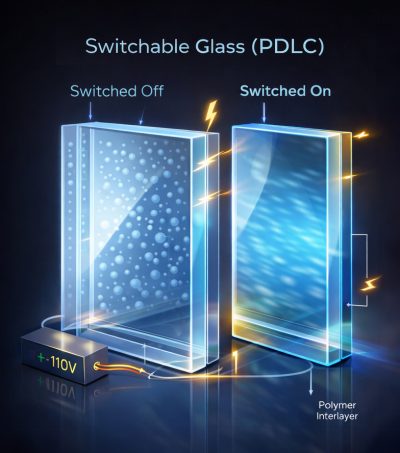
Simplified diagram showing how PDLC liquid crystals align when power is applied, switching Switchable™ glass from opaque to clear.
Key Benefits of Switchable™ Glass
Switchable™ glass offers a combination of functional and design advantages across a wide range of applications.
On-demand privacy
Privacy can be achieved instantly without blinds or curtains, making it ideal for environments requiring flexible visual control.
Clean, modern appearance
The absence of mechanical shading systems creates a minimal and contemporary design aesthetic.
Hygienic and easy to maintain
With no fabrics or moving parts, Switchable™ glass is suitable for healthcare and clean environments.
Light control and diffusion
In its opaque state, Switchable™ glass diffuses light evenly while maintaining brightness within a space.
Integration with smart systems
The glass can be connected to building automation, sensors, or remote control systems.
Space efficiency
Eliminates the need for physical blinds or partitions.
Limitations and Considerations
While Switchable™ glass provides many benefits, certain practical considerations should be understood.
- Requires electrical supply to maintain transparency
- Higher initial cost compared to standard glazing
- Installation must accommodate wiring and control systems
- Optical clarity may vary slightly depending on glass specification
- Not intended to replace full blackout shading where total darkness is required
Understanding these factors helps ensure the correct specification for each application.
Where Switchable™ Glass is Used
Switchable™ glass is used across a broad range of sectors where controllable privacy and modern glazing are required.
Commercial offices – meeting rooms, partitions, executive spaces
Healthcare environments – patient rooms, clinical areas, hygienic privacy zones
Residential spaces – bathrooms, internal partitions, feature glazing
Hospitality – hotel bathrooms, conference areas, private suites
Retail and display environments – dynamic visibility control
Specialist environments – security, controlled access, or clean spaces
Its versatility makes it suitable for both functional and architectural applications.
Switchable™ Glass vs Blinds, Curtains and Films
Switchable™ glass replaces traditional privacy solutions by integrating light and privacy control directly into the glazing.
Compared to blinds or curtains:
- No moving parts
- No dust or fabric maintenance
- Instant switching
- Cleaner visual appearance
Compared to privacy film:
- Integrated within laminated glass
- More durable and permanent
- Even optical performance
- Higher clarity when transparent
This makes Switchable™ glass particularly suitable where reliability and long-term performance are important.
Installation Overview
Switchable™ glass is installed as laminated glass incorporating a PDLC interlayer and electrical connections. During installation, low-voltage wiring is integrated into the glazing system and connected to a power supply and control interface.
Installation considerations include:
- Power routing and concealment
- Control system placement
- Glass specification and sizing
- Environmental and safety requirements
- Integration with existing glazing systems
Professional specification ensures optimal performance and longevity.
Lifespan and Maintenance
Switchable™ glass is designed for long-term operation with minimal maintenance. The laminated PDLC interlayer is protected within the glass structure, ensuring consistent performance over time.
Typical characteristics:
- Long operational lifespan
- Minimal mechanical wear (no moving parts)
- Standard glass cleaning methods apply
- Stable performance under normal operating conditions
Routine inspection of electrical components ensures continued reliability.
Energy Efficiency and Performance
Switchable™ glass contributes to energy performance through light diffusion and controlled transparency. While it is not a primary insulation system, it can assist in managing glare and light distribution within a space.
Key performance considerations:
- Even light diffusion in opaque mode
- Reduction of glare in bright environments
- Compatibility with energy-efficient glazing systems
- Low electrical consumption during operation
Cost Factors
The cost of Switchable™ glass varies depending on specification and application.
Key influencing factors:
- Glass size and thickness
- Laminated configuration
- Control system complexity
- Installation requirements
- Quantity and project scale
- Integration with other glazing systems
Due to its specialist technology, Switchable™ glass typically represents a premium glazing solution.
Frequently Asked Questions
Is Switchable™ glass safe?
Yes. Switchable™ glass is manufactured as laminated safety glass and can be specified to meet relevant safety standards.
Can Switchable™ glass be retrofitted?
In some cases, retrofitting is possible depending on existing glazing and electrical access.
Does Switchable™ glass require constant power?
Power is required to maintain the transparent state. When power is off, the glass returns to opaque.
How long does Switchable™ glass last?
With correct specification and installation, Switchable™ glass is designed for long-term use with stable performance.
Can Switchable™ glass be customised?
Yes. It can be produced in various sizes, shapes, and configurations depending on project requirements.
Is Switchable™ glass suitable for bathrooms?
Yes. It is commonly used in bathrooms and privacy-sensitive areas.
Explore More Expert Guides
For further technical guidance, comparisons, and detailed explanations, explore the full knowledge hub within Your Questions Explained, where specialist glass technologies, applications, and performance considerations are explained in depth.